
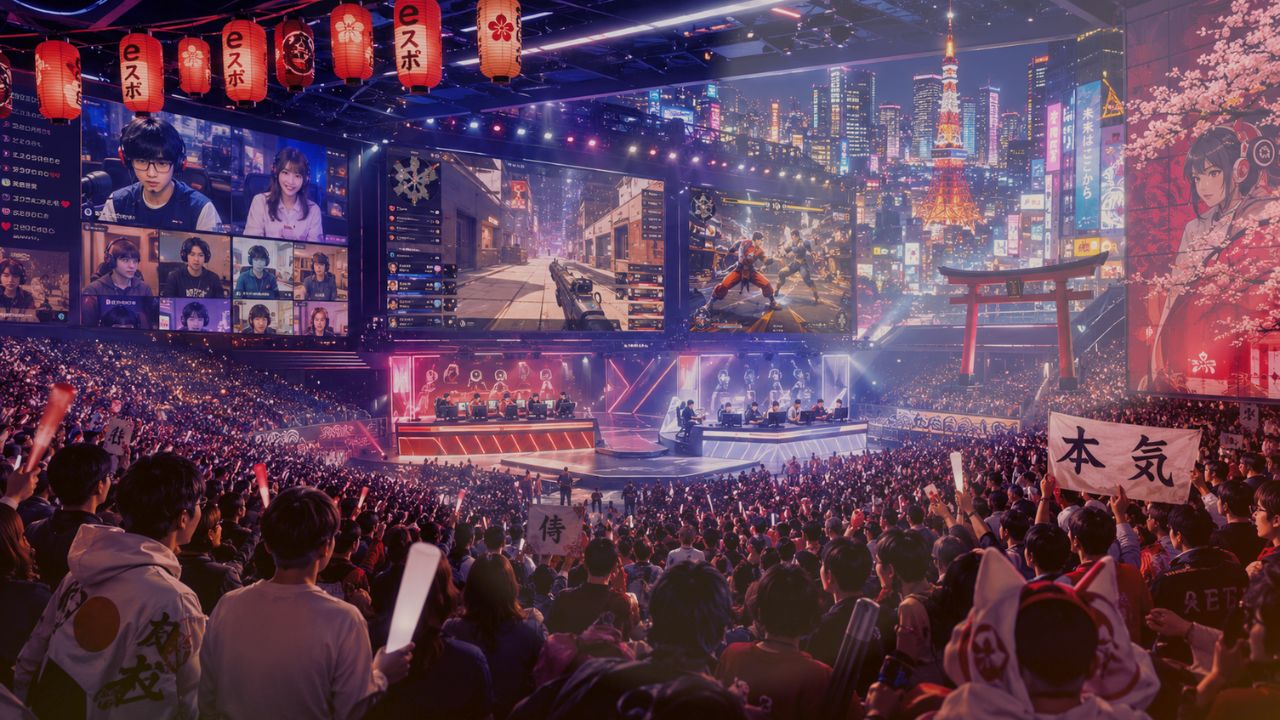
Japan has always been one of the spiritual capitals of gaming.
This is the country that gave the world Nintendo, Sony PlayStation, Capcom, SEGA, Bandai Namco, Konami, Square Enix, and FromSoftware. It shaped childhoods, defined genres, created icons, and turned pixels into mythology. From Super Mario to Street Fighter, from Final Fantasy to Dark Souls, Japan did not merely participate in gaming history. It authored entire chapters of it.
And yet, for years, one strange question has continued to surround Japan’s relationship with esports:
Why does one of the greatest gaming nations on Earth seem to have a smaller esports presence than its influence in gaming would suggest?
On paper, the gap is easy to see.
According to several industry estimates and market reports, Japan’s esports-related market is still relatively modest compared to other major esports countries. Japan’s esports market has been placed somewhere around 4.8–10 billion yen, or roughly US$30–65 million, depending on the exchange rate and the methodology used.
By comparison, China’s esports industry is operating at a completely different scale. The China Esports Industry Report 2024, cited by Esports Insider, placed China’s actual esports sales revenue at around 27.57 billion yuan, or approximately US$3.85 billion. The United States, based on figures cited in global market analysis reports, is estimated to be around US$1.23–1.24 billion in esports market size around 2025. South Korea, according to KOCCA-related data, recorded approximately 256.95 billion won in 2023, or around US$190–200 million, with some forecasts placing it above US$300 million by 2025.
In other words, if we compare Japan purely by revenue, the country appears far smaller than China, significantly smaller than the United States, and still below or around South Korea depending on which source and definition we use.
| Country | Approximate esports-related market scale |
|---|---|
| China | Around US$3.85 billion |
| United States | Around US$1.23–1.24 billion |
| South Korea | Around US$190–325 million |
| Japan | Around US$30–65 million |
But numbers can be honest and misleading at the same time.
They can tell us how much money is moving through a market, but not always how deeply a culture is changing. They can measure revenue, but not heat. They can quantify sponsorship, but not obsession. They can compare business size, but not emotional gravity.
And that is where Japan becomes interesting.
Because the more closely one looks at Japanese esports today, the harder it becomes to call it simply “behind.” A better description may be this: Japan missed the first dominant version of modern esports, then began building its own.
Not weaker. Not necessarily smaller in cultural impact. Just different.
To dig deeper into this, we reached out to Mizuiro, Editor-in-Chief of GAMEZINE, a Japanese esports magazine launched in 2015. GAMEZINE describes itself as a media platform that aims to make esports more accessible to the public while shining a light on the dramas created by players, teams, casters, and tournaments. More importantly, it positions itself as a bridge between athletes, teams, fans, and their wider communities.
That mission matters, because the story of esports in Japan is not only about business size. It is also about culture, emotion, storytelling, and the slow transformation of competitive gaming into something much larger than tournaments.
When asked why Japan’s esports presence seemed smaller than its gaming legacy, Mizuiro gave a direct but nuanced answer.
“From an overseas perspective, it’s completely natural to wonder, ‘Why is a gaming superpower lagging behind?’”
But he also argued that the perception of Japan being “behind” is now outdated.
“Looking at the latest data and the sheer enthusiasm of the market, I can confidently say that the perception of Japan being ‘behind in esports’ is a relic of the past.”
That may sound surprising if we only look at revenue charts. But Japan’s esports story cannot be understood through revenue charts alone.
Also read: How Saudi Arabia Is Redefining Esports Through the EWC
The country that did not need PC esports
To understand Japan’s slower start in modern esports, we need to begin with the irony at the center of the story: Japan’s early “weakness” in esports came partly from its overwhelming strength in gaming.
In many countries, modern esports grew from PC culture. Internet cafés, LAN centers, free-to-play online games, MOBAs, tactical shooters, and competitive ladders became the foundations of a new spectator economy. Titles such as League of Legends, Counter-Strike, Dota, and later VALORANT became central to how competitive gaming was understood globally.
Japan’s gaming history followed a different road.
For decades, Japanese players had access to some of the best console gaming experiences in the world. The Famicom, Super Famicom, PlayStation, and later Nintendo and Sony ecosystems made the living room the natural home of play. At the same time, arcades gave players a physical space for direct competition. If someone wanted to test themselves against others, they did not necessarily need a gaming PC, a LAN café, or an imported online ecosystem. They could go to a game center.
As Mizuiro explained, Japan had already built “the world’s most successful, unique market for home consoles and arcade games.” Because that ecosystem was already so rich, the culture of building expensive PCs to play overseas competitive titles took longer to take root.
This is why the old perception of Japan as “behind” was not completely baseless. Japan did miss the first global wave of esports built around PC gaming, free-to-play economies, and online competitive ecosystems. The country was not early in the same way South Korea was with StarCraft, nor did it develop the same massive publisher-and-platform-driven esports structure as China.
But to say Japan was simply behind is too lazy. It is like judging a train for not being an airplane. Technically true in one sense, very silly in another.
Japan was not absent from competitive gaming. It was competitive through arcades, fighting games, local communities, and console culture. Its foundation was just different.
Fighting games were never a side story in Japan
Any serious discussion of Japanese esports has to begin with fighting games.
Street Fighter, Tekken, and Super Smash Bros. are not just games. They are cultural institutions. They carry decades of muscle memory, rivalry, pride, and community history. Japan’s connection to fighting games is not accidental. It grew from the arcade, a place where competition was immediate, physical, and social.
In the arcade, there was no algorithm trying to recommend the next match. No ranked ladder hidden behind a screen. No distant opponent with a username you would never remember.
There was a cabinet. A seat. A challenger. A crowd, sometimes small, sometimes loud. Victory and defeat happened in public.
That matters.
Mizuiro pointed to the existence of Japanese “game centers” as a major factor behind the country’s fighting game culture. There was an era where stopping by the arcade after school and playing against whoever happened to be there was part of everyday life. That physical environment shaped the community.
This is why Japanese excellence in fighting games feels so deeply rooted. It is not merely about producing strong players. It is about a competitive culture that had decades to form before the word “esports” became fashionable.
But fighting games no longer define the whole Japanese scene.
That is one of the most important changes happening today. Mizuiro noted that while Street Fighter and Tekken remain essential, younger audiences have also embraced FPS titles such as VALORANT, Apex Legends, and Overwatch. Mobile titles such as Identity V and Brawl Stars also command serious fan energy.
In his words, fighting games are “definitely an essential genre in Japanese esports,” but no longer the only mainstream.
That diversity is crucial. Japan is no longer just the land of fighting game legends. It is becoming a broader esports culture with multiple entry points, multiple fandoms, and multiple styles of competition.
Japan’s competitive credibility is no longer theoretical
For years, the argument against Japan was not only commercial. It was competitive. Japan was often respected in fighting games, but questioned in PC esports, tactical shooters, and broader global titles.
That too has changed.
Mizuiro pointed to several examples: Japanese success in fighting games, ZETA DIVISION’s back-to-back world championships in Brawl Stars, REJECT winning an official PUBG MOBILE global tournament, and Japanese teams achieving strong international results in VALORANT, Rainbow Six Siege, and Apex Legends.
Japan is no longer merely appearing on the international stage. In several titles, it has become dangerous.
That distinction matters. A market can grow through business investment, but legitimacy often comes from moments: a deep tournament run, an unexpected upset, a packed arena, a player becoming a national symbol for fans who stayed awake until morning to watch.
Japan has started collecting those moments.
During VCT 2022 Masters Reykjavík, for example, domestic Japanese viewership reportedly surpassed 290,000 concurrent viewers despite the difficult late-night or early-morning broadcast hours. Community events such as CR Cup, which blend professional players and streamers, have reportedly exceeded 500,000 concurrent viewers.
Those numbers tell us something that revenue alone cannot.
Japan may still be smaller as a business market, but it is not small as an attention market.
The rise of the streamer-athlete ecosystem
The most important thing to understand about Japanese esports today is that it cannot be separated from streamer culture.
In many markets, there is still a fairly clear distinction between professional esports and gaming entertainment. There are pro players on one side, streamers and content creators on another, and casual fans somewhere in between.
Japan has blurred those lines more aggressively.
Professional players, streamers, VTubers, musicians, actors, comedians, and fans often exist in the same cultural orbit. Watch parties are not a secondary viewing experience; they are one of the main gateways into esports. A fan may first encounter a tournament not because they follow the league, but because their favorite streamer is watching it. From there, they become curious about the players. Then the teams. Then the rivalries. Then the story.
As Mizuiro put it, streamers and VTubers are not overshadowing competitive esports. Instead, “they are positively influencing each other.”
That relationship is incredibly powerful.
It transforms esports from a competition that people must already understand into an entertainment world they can gradually enter. The streamer becomes the translator. The watch party becomes the doorway. The tournament becomes not just a match, but a social experience.
This is where Japan’s model starts to look less like a delayed version of Korea or China, and more like an advanced version of something else entirely.
Japan is not merely asking, “How do we make people watch esports?”
It is answering a more modern question: How do we make esports part of people’s lifestyle?
The answer appears to be a fusion of competitive drama, personality-driven fandom, content creation, offline spectacle, merchandise, and emotional attachment. This is not esports as a standalone sports product. This is esports as pop culture infrastructure.
Oshi-katsu and the emotional economy of fandom
One of the most distinct elements of Japan’s esports culture is the influence of oshi-katsu, the practice of actively supporting one’s favorite idol, performer, character, creator, or public figure.
Applied to esports, this changes the fan relationship.
In a traditional sports model, fans often support teams because of geography, history, winning tradition, or inherited identity. In esports, especially in Japan, support can be more intimate and personality-driven. Fans may support a player not only because they are strong, but because of their story, their humor, their vulnerability, their effort, their streaming persona, or the emotional journey they share with the audience.
Mizuiro explained that Japanese fans do not only support players because they are strong. They connect with “their personalities and stories,” cheering for them almost like idols.
This creates a different kind of commercial foundation.
A team does not have to rely only on prize money, tournament results, or sponsorship impressions. It can build around merchandise, fan events, content, membership, collaborations, and personal attachment. In this model, the player is not only an athlete. They are also a character in an ongoing story.
That may sound less “serious” to traditional sports purists, but in modern entertainment, emotional attachment is the business model. The strongest fandoms are not built only on excellence. They are built on proximity.
Fans want to feel close to the people they support. They want the win, yes. But they also want the behind-the-scenes video, the post-match reaction, the awkward livestream moment, the comeback arc, the friendship, the heartbreak, the human texture.
Japan understands this unusually well.
And that may be why some Japanese esports organizations generate massive online attention even if the country’s overall market revenue still looks modest compared to China or the United States.
The money has not fully caught up to the emotion yet.
But the emotion is already there.
Check out another essay: The Myth That Refuses to Die: Video Games and Violence
The ZETA DIVISION signal
Few examples capture Japan’s modern esports shift better than ZETA DIVISION.
ZETA is not only a competitive organization. It is a cultural signal. Its popularity represents the fusion of esports, content, fandom, fashion, and identity.
Mizuiro cited rankings from live-streaming analytics tools showing that ZETA DIVISION became one of the most watched esports organizations on Twitch, even taking first place globally for two consecutive years in 2024 and 2025. According to him, the organization was watched for more than 100 million hours a year.
Whether we look at ZETA as an esports team, a content brand, or a lifestyle symbol, its rise challenges the old assumption that Japan lacks esports energy.
Japan may not always dominate every game competitively. Its market may still be smaller in revenue. But audience passion is not small.
That distinction matters.
A country can have a developing business model and a mature fandom at the same time. Japan seems to be in exactly that position. The monetization layer is still catching up, but the audience layer is already powerful.
This is why judging Japan purely by market size misses the deeper movement. Esports in Japan is not only growing through league structures or prize pools. It is growing through attention, affection, and cultural convergence.
In the modern internet economy, that is not a side dish. That is the main course.
From “gaming tournament” to entertainment festival
Another major shift is the evolution of offline events.
In the past, esports events in Japan were often viewed as extensions of gaming expos or niche gatherings for hardcore players. A tournament might occupy a corner of a larger event, surrounded by product booths and curious passersby.
That image is increasingly outdated.
Mizuiro described how major tournaments like VALORANT now fill massive venues such as Saitama Super Arena and Yokohama Arena. These are not small gatherings for people who accidentally wandered in after buying a mousepad. They are full-scale entertainment productions.
Lighting. Sound. Music. Stage design. Chants. Fashion. Merchandise. Social media moments.
The atmosphere is closer to a music festival than an old-school gaming competition.
This matters because it changes how esports is perceived by brands, media, and the general public. When an event looks and feels like mainstream entertainment, it becomes easier for non-endemic sponsors to enter. And that is already happening. Japanese esports is no longer sponsored only by PC peripheral brands and energy drinks. Apparel, cosmetics, food, automotive, and lifestyle brands are increasingly part of the picture.
As Mizuiro argued, esports in Japan is no longer treated as a niche separated from other entertainment industries. Instead, it has become a hub that mixes with music, fashion, anime, and mainstream celebrity culture.
That shift says something profound: esports is no longer being treated merely as a way to sell games. It is becoming a youth culture platform.
And that is the point where esports stops being a niche and starts becoming infrastructure for influence.
The prize pool myth and the real bottleneck
For years, one of the most repeated explanations for Japan’s slower esports growth was regulation, especially the belief that prize pools were effectively capped at 100,000 yen due to legal concerns around promotional prizes.
There is truth in that history. The perception that large prize pools were legally difficult did create hesitation. It discouraged investment, confused organizers, and contributed to the idea that professional gaming was not a viable career path in Japan.
But that issue is no longer the defining obstacle it once was.
Mizuiro explained that legal interpretations have become clearer, and large prize pools are now possible in Japan. Tournaments with tens of millions, and in some cases even hundreds of millions of yen, are no longer unthinkable. The old idea that Japan simply “cannot do big prize money” belongs more to the past than the present.
However, Japan still faces structural limitations. One notable issue is gambling-related regulation. In some countries, tournament prize pools can be funded through participant entry fees. In Japan, that remains legally difficult. This limits certain grassroots and semi-professional tournament models.
But even here, the deeper lesson is that prize money was never the whole story.
Unless an event is operating at a truly massive international scale, prize money alone does not sustain an esports ecosystem. It may attract attention, but it does not build culture by itself. Teams do not survive only because tournaments pay large prizes. They survive because fans care, sponsors see value, content travels, and stories create repeat engagement.
Mizuiro’s most interesting point here is that Japan may have spent too much time focusing on the prize money issue while overlooking a more fundamental challenge: how to deliver “cool” creative content and compelling stories that actually captivate audiences.
That is a crucial insight. The industry did not only need permission to pay winners.
It needed the confidence to entertain.
Japanese work culture versus passion culture
Another common question is whether Japan’s famous work culture affects how young people view careers in gaming and esports.
For older generations, the concern is understandable. A stable company job remains the default dream for many parents. Professional gaming, streaming, or content creation can seem risky, unstable, even irresponsible.
But younger generations are shaped by a different reality.
They grew up watching people build careers on YouTube, Twitch, TikTok, and other platforms by being intensely themselves. They have seen creators become celebrities, streamers become entrepreneurs, and players become cultural icons. For them, pursuing gaming is not necessarily a rejection of discipline. It is a different form of discipline, driven by immersion rather than obligation.
Mizuiro described this as the “overwhelming power of pure immersion” — the ability of young people to dive deeply into what they truly love.
That phrase captures something important.
From the outside, a young player grinding ranked matches for thousands of hours may look like someone trapped in unhealthy obsession. Sometimes, that concern is valid. But in many cases, what looks like harsh discipline from the outside feels like devotion from the inside.
They are not always forcing themselves because society told them to work hard. They are working hard because they love the world they have entered.
That passion can be dangerous if exploited. But it can also be extraordinary if supported properly.
Japan’s next challenge is to build systems around that passion: education, coaching, health support, career planning, second-career pathways, and a healthier bridge between competition and content creation.
The good news is that Japan already has one advantage here. Streaming offers retired or semi-retired players a visible second career. That reduces the cliff that many esports athletes face when their competitive peak ends. In a young industry where careers can be brutally short, that matters enormously.
High school esports and the future pipeline
One of the most promising signs for Japan’s future is the growth of high school esports.
This may become one of the country’s most important long-term advantages. Japan understands school-based club culture. Baseball, soccer, volleyball, and many other sports have grown through structured youth environments where students compete, build identity, and dream of reaching the next level.
If esports can develop a similar pathway, Japan could build a much deeper talent ecosystem.
Mizuiro sees this as one of the major reasons to be optimistic about Japan’s next three to five years. As high school esports becomes more established, the player base can deepen. More young players can gain experience earlier. A more stable pathway can emerge from school competition to professional teams, and eventually to international success.
The future vision is not difficult to imagine: school clubs feeding into regional competitions, regional competitions feeding into professional teams, professional teams feeding into international success, and national pride forming around esports the way it has around traditional sports.
That does not happen overnight. It requires coaching standards, tournament infrastructure, safeguarding, parental trust, and a clearer understanding of esports as more than screen time. But Japan has cultural familiarity with school-to-pro pathways. If adapted carefully, this could become a powerful foundation.
In the next three to five years, Japan may not catch China in scale. China’s population, market size, publisher ecosystem, and state-level support create a different category of growth. But Japan does not need to become China to become globally important.
A more realistic comparison is South Korea.
Not necessarily in identical structure, but in cultural penetration: dedicated venues, weekend spectatorship, visible stars, youth development, and public recognition. Japan already has the audience passion. The next step is making esports a normal part of everyday entertainment.
Not an occasional event. Not a novelty.
A weekend plan.
Japan’s real esports identity
The mistake many observers make is assuming that esports development has only one correct path.
First PC bangs. Then professional leagues. Then major sponsors. Then stadiums. Then mainstream acceptance.
That path worked in some countries. But Japan is showing another possibility.
Its path runs through arcades, consoles, fighting games, streamers, VTubers, idol-like fandom, arena events, fashion brands, school competitions, and watch parties. It is less linear. Less institutional at first glance. More emotionally networked.
It may not look like traditional esports development.
But maybe that is the point.
Japan’s esports scene today is not simply trying to recreate South Korea’s PC bang culture, China’s giant commercial machinery, or America’s media-and-sponsorship model. It is becoming something that reflects Japan’s own entertainment DNA.
That DNA values character. Craft. Community. Ritual. Fandom. Presentation. Emotional continuity.
In Japan, esports is not only about who wins. It is about who people choose to follow, support, wear, quote, watch, defend, and believe in.
That might sound soft compared to the hard language of revenue charts. But every strong entertainment industry is built on soft power before it becomes hard business.
The market is smaller. The meaning is not.
So where does that leave Japan?
On paper, Japan’s esports market remains smaller than the giants. China is far ahead, with esports revenue in the multi-billion-dollar range. The United States has a larger commercial base, sitting around the low-billion-dollar mark. South Korea still carries historic legitimacy, institutional depth, and a market that remains larger than Japan’s by many estimates.
Japan, by comparison, is still often measured in the tens of millions of dollars.
But if we judge by cultural fusion, audience engagement, streamer integration, fandom behavior, and the transformation of esports into lifestyle entertainment, Japan becomes one of the most fascinating markets in the world.
It is not merely catching up.
It is mutating the form.
Japan reminds us that esports is not only a sport, not only media, not only gaming, and not only entertainment. It is all of them at once, depending on who is watching and why they care.
For some, it is competition.
For others, it is community.
For others, it is identity.
For others, it is a favorite player smiling on stream after a painful loss and making fans believe they will come back stronger.
That is the part market reports struggle to measure.
Japan may still be converting its cultural heat into commercial scale. But the heat is real. The arenas are filling. The watch parties are working. The streamers are opening doors. The teams are becoming lifestyle brands. The fans are not just watching matches; they are practicing devotion.
So perhaps the old question needs to be retired. The question is no longer: “Why is Japan behind in esports?”
The better question is: “What happens when one of the world’s greatest gaming cultures finally decides to make esports its own?”
The answer is still being written.
But it is already loud, emotional, stylish, and very Japanese.