
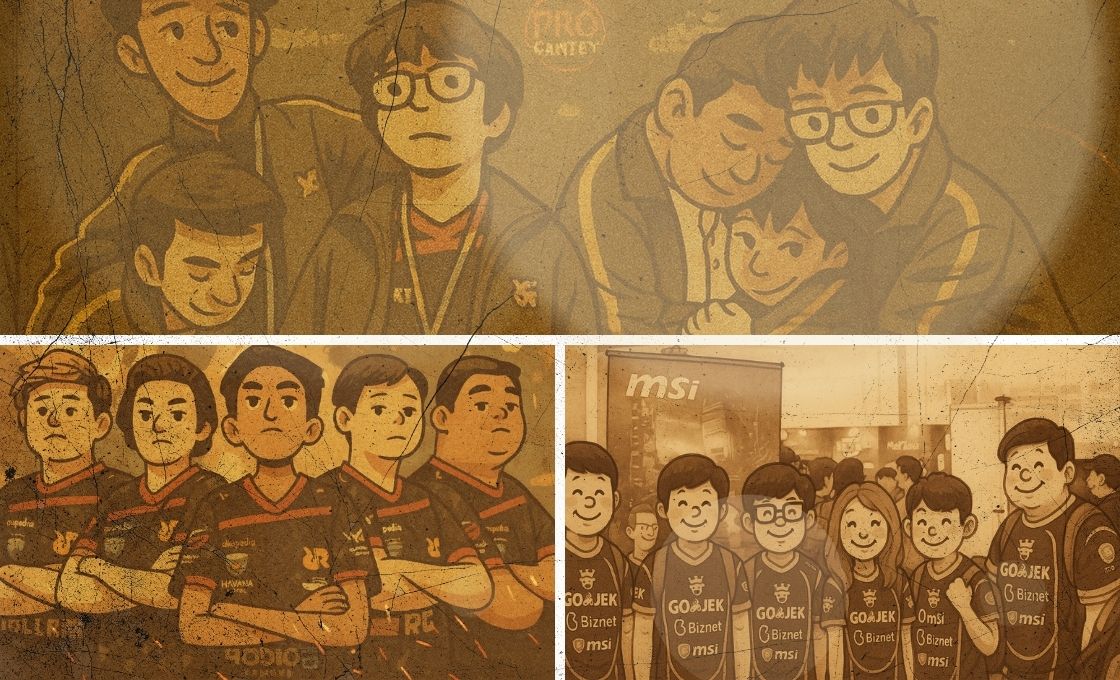
Chapter 1 – The Rise of the King: From DotA to Dota 2
Before Rex Regum Qeon became a giant in Indonesian esports, it was born from something very simple: a dream and the passion of a community.
In 2013, Dota 2 had just begun to replace the game that raised it—DotA (Defense of the Ancients), a custom mod in Warcraft III: The Frozen Throne. The esports world was shifting. From internet cafés to big stages. From hobby to profession. From loose groups of talented players to structured organizations with long–term ambitions.
It was at this turning point that RRQ was born.
Check out this article too: The Myth That Refuses to Die: Video Games and Violence
From Fnatic XCN to RRQ: The Beginning of a Legend
One of the most important figures in this first chapter is Farand “KoaLa” Kowara.
Today, his name is etched into Indonesian esports history—and as of October 2025, he is still active as a coach for Army Geniuses.
Koala started his journey in the DotA era, when esports was far from being taken “seriously.” Imagine this: in 2008, when most young players were still playing in internet cafés just for fun, Koala was already representing Fnatic XCN, an Indonesian team affiliated with the international organization Fnatic. He was only 19 years old.
Five years later, at the end of 2013, Koala and several other big names were brought together to form a team that would carry Indonesia’s competitive spirit onto the Asian stage.
That team was called Rex Regum Qeon—Latin for “King of Kings.”
Asian Cyber Games 2013: RRQ’s Ground Zero
The 2013 Asian Cyber Games, often referred to as The Asia, was the first tournament where the name RRQ was officially recorded in history.
The RRQ roster at the time included several players who are now recognized as pioneers of Indonesian Dota 2: Koala, Azam “Nafari” Aljabar, Ritter, Rene “Minerva” Michael Halim, Jeffry “Gehenna” Martin Suhendra, Albert “DonXwaN” Ludong, and Muhammad “bubu” Damar.
They played with heart on the international stage, even if the final result was not yet spectacular. But behind the scenes, something more important began to grow: an identity, a family, and the foundation of a legacy.
More Than Just a Team
RRQ was never just a competitive project. For those who were there at the beginning, RRQ was a home.
A home for players who wanted to prove that Indonesia could stand shoulder to shoulder with the top teams in Asia. This is where RRQ’s spirit was forged—a spirit that would later be carried across many esports divisions.
The First Failure, the Greatest Lesson
The year 2014 became a major test. RRQ attempted to qualify for The International 4 (TI4) through the SEA Qualifier—an event that every Dota 2 player in the world dreams of reaching.
The result was bitter. They failed to reach the main event. After that, RRQ chose to “reset” itself: releasing the old roster, restructuring the team, and starting again from scratch.
Yet for RRQ, that failure was not an ending. It was the beginning of a long journey—a journey that would carry them through multiple generations, victories, and tears.
RRQ Dota 2 Roster – 2013
- Ritter “Ritter” Rusli
- Rene “Minerva” Michael Halim
- Albert “DonXwaN” Dick Ludong
- Farand “KoaLa” Kowara
- Jeffry “Gehenna” Martin Suhendra
- Azam “Nafari” Aljabar Nafari
- Muhammad “bubu” Damar
RRQ Dota 2 Roster – 2014
- Albert “DonXwaN” Dick Ludong
- Farand “KoaLa” Kowara
- Jeffry “Gehenna” Martin Suhendra
- Azam “Nafari” Aljabar Nafari
- Muhammad “bubu” Damar
- Yusuf “Yabyoo” Kurniawan
- Henry “Xing” Tan
- Ega “Nivis” Tanzil
- Egi “Indigo” Tanzil
- Agustian “PhoeniX” Hwang
Chapter 2 – Years of Hope (2015–2016)
After the painful farewell of 2014, RRQ went quiet. The Dota 2 world kept moving, but the King was not dead—it was preparing for a comeback.
In early 2015, RRQ returned, not with grand promises, but with renewed determination. The familiar names like Gehenna and Minerva were no longer on the roster, but the spirit they left behind still burned strongly.
This time, RRQ came with a new line–up: Amz, Xepher, bubu, Nafari, SCL, and Panda—young Indonesian talents hungry to prove themselves.
2015: The King’s Rebirth
Many did not expect RRQ’s 2015 comeback to become such an important turning point.
At the South East Asia Dota 2 Championship, they claimed first place and brought home a prize of USD 5,000. It may sound small today, but at that time it was a powerful statement: RRQ was back and ready to fight.
Not stopping there, they also finished in the top two at the Asian Cyber Games SEA Invitational.
Amid rapid roster changes and brutal competition, RRQ stayed on its feet. Every win, no matter how small, was a reminder that Indonesia’s voice could still be heard on the Asian stage.
A Growing Family
Dota 2 is not just about micro and macro. It is also about trust.
And trust is born from the relationships between players.
During this period, many names came and went—Amz, Xepher, Yabyoo, Xing, Nivis, Indigo, and others. Each one added a unique color to RRQ’s story. Some would later become big stars in the wider Dota 2 scene. But in those years, they all stood under one banner: RRQ.
2016: From Open Qualifiers to the Asian Stage
RRQ continued to battle at the regional level. They won the BTS SEA #4 Open Qualifier, then took second place at ProDota SEA Cup #3. These results might not have earned today’s DPC points, but for the Indonesian Dota community, RRQ was a source of pride.
They were not a team packed with international superstars, but they had something just as valuable: persistence. That persistence kept them going even when prize pools were small and the spotlight was rare.
Clara “Mongstar” and a New Era for RRQ
Around 2016, a new figure joined RRQ Dota 2: Clara Kartikasari Utoyo, now better known as Mongstar. She had just moved to Jakarta after graduating, and RRQ became her first workplace in the capital—serving as team manager for RRQ Dota 2.
At the time, not many realized it, but Mongstar would go on to become one of the most recognizable faces in the Indonesian esports scene. From behind the scenes, she witnessed the ups and downs of RRQ Dota 2, learning about passion, strategy, and the meaning of “family” in such a tough industry.
These years shaped RRQ into a more mature organization.
They were no longer just a team chasing victories—they had become a symbol of Indonesian esports spirit: relentless and unwilling to give up.
Check out one of our Editor’s Choice: Does Esports Need Physical Aptitude? A Scientific Reexamination of the Gamer’s Body
Xepher: From RRQ to The International
One of the most inspiring stories from this era belongs to Kenny “Xepher” Deo, who played for RRQ between 2015 and 2016.
Xepher kept pushing forward and finally, in 2021, he made it to The International 10 (TI10) alongside Whitemon.
He became one of the first two Indonesian players ever to qualify for TI—an achievement that highlighted how significant RRQ’s role had been in nurturing top–tier talent in Indonesia.
RRQ Dota 2 Roster – 2015
- Farand “KoaLa” Kowara
- Vinzent “oddie” Indra (Player, later transitioned to Team Manager)
- Ario “Panda” Susilo
- Azam “Nafari” Aljabar Nafari
- Muhammad “bubu” Damar
- Ruby “SCL” Gunawan
- Yusuf “Yabyoo” Kurniawan
- Henry “Xing” Tan
- Angga “Amz” Julia
- Kenny “Xepher” Deo
- Ega “Nivis” Tanzil
- Egi “Indigo” Tanzil
- Agustian “PhoeniX” Hwang
RRQ Dota 2 Roster – 2016
- Farand “KoaLa” Kowara
- Michael “KelThuzard” Samsir
- Rizki “Varizh” Varizh
- Ahmad “ADTR” Syazwan
- Kenny “Xepher” Deo
- Yusuf “Yabyoo” Kurniawan
- Clara “Mongstar” (Team Manager)
Chapter 3 – A Golden Era and an Endless Fight (2017–2018)
When the name Rex Regum Qeon once again echoed on the big stages of Dota 2, it was not due to luck. It was the result of relentless hard work.
2017: A Busy Year Full of Sparks
By 2017, RRQ’s Dota 2 division was becoming more structured. The roster was more stable, and the team had a clearer direction. Koala remained a central figure—not only as a player, but also as a leader and mentor for the next generation.
From 2016 to 2017, a mix of young talents and veterans colored RRQ’s Dota 2 division. Big names from Indonesian Dota 2 history—such as Varizh, KelThuzard, ilLogic, and Azur4—were part of this era, each leaving their own mark.
This combination carried RRQ onto several major stages. They finished top 3 at the Indonesia Games Championship (IGC 2017) and top 3 at the WCA 2017 APAC Qualifier.
For RRQ, this wasn’t just about trophies. It was proof that after years of grinding, they could once again compete at the Asian regional level.
This year was also a major personal milestone for Farand “KoaLa” Kowara.
After more than four years carrying the RRQ name, Koala decided to retire as an active player on 22 December 2017. Yet he never truly left—he immediately transitioned into the role of coach.
2018: The Year RRQ Made History
For Indonesian Dota 2 fans, 2018 is unforgettable.
For the first time ever, an official Dota Pro Circuit (DPC) tournament was held in Indonesia—GESC: Indonesia Dota 2 Minor.
And who stood on that grand stage as the home representative?
Rex Regum Qeon.
RRQ qualified through the national qualifiers and played alongside global giants like Evil Geniuses, NaVi, and Fnatic. They finished 7th–8th, but the pride and attention they brought home were far greater than the placement.
For the first time, Indonesian fans could chant the name of their own team on a DPC stage:
“RRQ! RRQ! RRQ!”
R7 – From Dota Offlaner to MLBB Royalty
In 2017, RRQ welcomed Adi “Acil” Syofian Asyauri, who would later become a highly successful MPL coach. In 2018, another key figure arrived: Rivaldi “R7” Fatah.
He joined RRQ’s Dota 2 division as a young player brimming with potential—calm, hardworking, and deeply curious.
Few could have predicted how far R7’s journey would take him.
Although many claim that mobile MOBAs are easier than their PC counterparts, the reality is that no former Indonesian Dota 2 or League of Legends player has achieved the level of success R7 eventually found in Mobile Legends. He is not just a “Dota player who switched to MLBB.” He is living proof that the mentality of a true competitor transcends platforms.
R7’s path was not without obstacles. When he first moved to MLBB, he could only play two heroes properly. But, true to RRQ’s philosophy, he never stopped learning.
Step by step, he improved until he was recognized as one of Indonesia’s best EXP laners—even years after his retirement from professional play.
R7 is more than a symbol of a successful transition between games. He embodies perseverance, discipline, and humility—the three core values at the heart of RRQ’s spirit.
Light Amid Change
Behind the achievements and spotlight, Dota 2 in Indonesia faced real challenges.
Prize pools were modest, the local scene was unstable, and more and more players started moving to mobile titles. Many teams struggled to survive.
RRQ, however, refused to give up.
In every match and every qualifier, they played not just for prize money, but for their name, for pride, and for their love of the game that raised them.
RRQ Dota 2 Roster – 2017
- Farand “KoaLa” Kowara (Player, later transitioned to Coach)
- Bruce “ilLogic” Ervandi
- Muhamad “Azur4” Luthfi
- Michael “KelThuzard” Samsir
- Jun “Bok” Kanehara
- Nicholas “Eden” Thie
- Rizki “Varizh” Varizh
- Ahmad “ADTR” Syazwan
- Adi “Acil” Syofian Asyauri
- Yusuf “Yabyoo” Kurniawan
- Kenny “Xepher” Deo
- Clara “Mongstar” (Team Manager)
RRQ Dota 2 Roster – 2018
- Farand “KoaLa” Kowara
- Rusman “Rusman” Hadi
- Rivaldi “R7” Fatah
- Augustus “xRag” John Casanada
- Yusuf “Yabyoo” Kurniawan
- Kenny “Xepher” Deo
- Adi “Acil” Syofian Asyauri
- Sivasubramaniam “Ara” Aarathanan (Coach)
Chapter 4 – The End of an Era (2019)
Every great journey has an ending. But not every ending means the story is over.
Early 2019: Fighting Through the Storm
The year 2019 began with the same fighting spirit—but with heavier pressure than ever. The Southeast Asian Dota 2 scene was changing. Many veterans retired, major organizations left the title, and sponsors shifted their focus to booming mobile games like Mobile Legends and PUBG Mobile.
In the midst of this turbulence, RRQ kept trying to hold on. Their early–2019 roster featured Rusman, R7, Acil, Yabyoo, and xRag—familiar faces who had been battling under RRQ’s banner since 2017–2018. They participated in various competitions, including ESL Indonesia Championship Season 1, where RRQ finished 5th and took home USD 2,000.
But behind the scenes, everybody understood how real the pressure was.
Finding new players of the right caliber became increasingly difficult. Scrim schedules grew thin. Local tournaments became fewer and fewer. Eventually, all that remained was the love of the game—but passion alone was not enough to cover substantial operational costs.
RRQ Dota 2 Roster – 2019
- Rusman “Rusman” Hadi
- Yusuf “Yabyoo” Kurniawan
- Rivaldi “R7” Fatah
- Augustus “xRag” John Casanada
- Adi “Acil” Syofian Asyauri
25 April 2019: The Day the King Said Goodbye
On that day, RRQ made an official announcement: the Dota 2 division was shutting down.
There was no drama, no grand farewell event. Just a single post on social media, followed by messages of gratitude from players and managers. Media outlets like Hybrid and Esports ID reported on the reasons behind the decision: the difficulty of assembling a competitive roster, a shrinking talent pool, and the harsh realities of the Dota 2 ecosystem in Indonesia.
“We tried, over and over again, but in the end it was hard to find a solid composition that could compete at the regional level,” said RRQ’s Head of Team Manager at the time—his voice heavy, but sincere.
For some fans, the news felt like losing a part of history.
For those who knew the struggle from the beginning, RRQ Dota 2 was more than a team. It was a symbol—proof that Indonesia once had a squad that stood tall on the international stage, proudly carrying the name Rex Regum Qeon.
The Story Continues: RRQ.Trust
In the same year, something interesting happened. RRQ announced a partnership with Thai team Trust Gaming, forming RRQ.Trust.
Featuring strong Thai players like Boombell, Fearless, and Q, RRQ.Trust quickly made noise in the Southeast Asian scene. They won ESL Thailand Championship Season 2 and finished 3rd at ESL Clash of Nations Bangkok 2019, with peak live viewership nearing 18,000.
For many, RRQ.Trust felt like a “reincarnation” of RRQ Dota 2’s spirit—this time based in Bangkok instead of Jakarta. Sadly, this new journey also did not last long.
RRQ.Trust Roster
- Worawit “Q” Mekchai
- Poomipat “Fearless” Trisiripanit
- Kittikorn “MyPro” Inngoen
- Anurat “Boombell” Praianun
- Sur “Tigger” Peerapat
From Player to President: The Story of Agustian Hwang
Among the many familiar names that fans often hear—R7, Mongstar, Acil—there is another story just as inspiring from the RRQ Dota 2 family: the story of Agustian “PhoeniX” Hwang and Nadya Sulastri.
Agustian was once part of RRQ’s journey not only as a player, but also as a team manager—a figure behind the scenes who helped maintain harmony and direction within the team.
Nadya held a similar role, bridging players and management, making sure every element of the team moved with the same vision.
Years passed, and their path led them to a bigger stage. Today, Agustian serves as President of MET Global (formerly Mineski Event Team), one of the largest esports event organizers in Southeast Asia.
Under his leadership, MET has become the backbone of numerous major tournaments, including MPL Indonesia since Season 3. Meanwhile, Nadya now serves as Indonesia’s Country Representative at Mineski Global, continuing her contribution to esports on a much broader scale.
Their story shows that RRQ’s legacy is not always measured in trophies or titles.
Sometimes, that legacy lives on in leaders shaped by competition—leaders who carry the same values of hard work, loyalty, and love for the scene that raised them. Agustian and Nadya’s journey proves that the RRQ family has produced not only great players, but also key stakeholders who now help shape the esports ecosystem in Indonesia and Southeast Asia.
Not an Ending, but a Legacy
When RRQ closed its Dota 2 division, many thought that chapter had ended.
History has shown otherwise. RRQ Dota 2 became a foundation. Without them, RRQ might never have grown into the powerhouse organization it is today.
They were the generation that sacrificed time, careers, and comfort to prove that Indonesia could compete.
And they succeeded.